Tag: grok

  • Tesla’s newest update expands blind-spot warning while parked, adds dashcam encryption and parental controls

    Tesla’s newest update expands blind-spot warning while parked, adds dashcam encryption and parental controls

    Tesla began rolling out software version 2026.20.6.1 to its fleet starting July 2, 2026, a quick follow-up patch built on the 2026.20.6 update that came before it. As of early July, the new version was still reaching cars in batches, according to rollout tracking site Teslascope, and it remains Tesla’s newest released version as of this writing, per Not a Tesla App’s running list of updates. The update does not add any major new driving features, but it changes several things that affect everyday ownership, including parking safety, dashcam privacy, and parental controls.

    The most safety-relevant change is a wider rollout of “Blind Spot Warning While Parked,” a feature meant to prevent so-called “dooring” accidents, where a driver or passenger opens a car door into the path of a passing cyclist, pedestrian, or vehicle. According to Tesla’s own release notes, when the system detects an approaching object while the car is parked, a chime sounds and the door will not open on the first press of the door button; occupants can override the warning by pressing again a moment later. Tesla also displays a visual warning: on cars with cabin ambient lighting, the door-side light strip turns red, and some models add a small red indicator light near the front pillar speaker grille, according to a report from Not a Tesla App. This update carries forward an expansion that brought the feature to the current Model Y and to 2021-or-newer Model S and Model X worldwide, adding to coverage that already included the Model 3 and Cybertruck, as reported by Teslarati. For an owner, this means the car may briefly resist opening a door if a bike or car is approaching from behind. That short delay is intentional, not a malfunction, and a second press will open the door regardless.

    The update also changes how dashcam footage is stored. Tesla’s cars continuously record from their external cameras, and owners can save clips to a USB drive for later viewing. Starting with this update, clips saved to USB are encrypted by default, meaning a saved clip can no longer simply be opened on any computer. To view or share a clip, an owner now needs to decrypt it first, either through the Dashcam app or at dashcam.tesla.com, according to Tesla’s release notes. Owners who prefer the previous behavior can turn encryption off from the touchscreen, under Controls, then Safety, then Encrypt Dashcam Recordings. The change mainly protects owners in the event a USB drive is lost or stolen, since dashcam footage can capture license plates, faces, and location information that owners may not want viewable by a stranger.

    A new parental-controls option lets an owner block the car’s Browser, Theater video-streaming app, and Arcade games entirely. The setting is turned on from Controls, then Safety, then Parental Controls, while the car is in Park, according to the same release notes. This gives parents or other primary drivers a way to keep those apps from being used from the driver’s or passenger’s seat at all, rather than relying on other family members to simply avoid them.

    Tesla’s in-car assistant, Grok, built by Elon Musk’s company xAI, also continues to expand under this software branch. The hands-free “Hey Grok” wake phrase lets an owner open the assistant by speaking, instead of tapping the screen or holding down the steering-wheel voice button, according to Tesla’s release notes. Tesla has separately been adding Grok to more countries in this same 2026.20 update series, including Chile, Malaysia, the Philippines, Thailand, Singapore, and Hong Kong, according to Not a Tesla App. Grok remains in early beta, and Tesla says it does not yet control car functions like climate or lighting; for now it mainly helps with navigation, including adding or editing destinations by voice command.

    Owners do not need to do anything to get 2026.20.6.1. Like all Tesla software, it downloads over Wi-Fi and installs automatically once the car is idle, and this same update cycle added the option to let updates install overnight on their own, according to Tesla’s release notes. Owners can check whether it has arrived by opening Controls, then Software, on the car’s touchscreen.

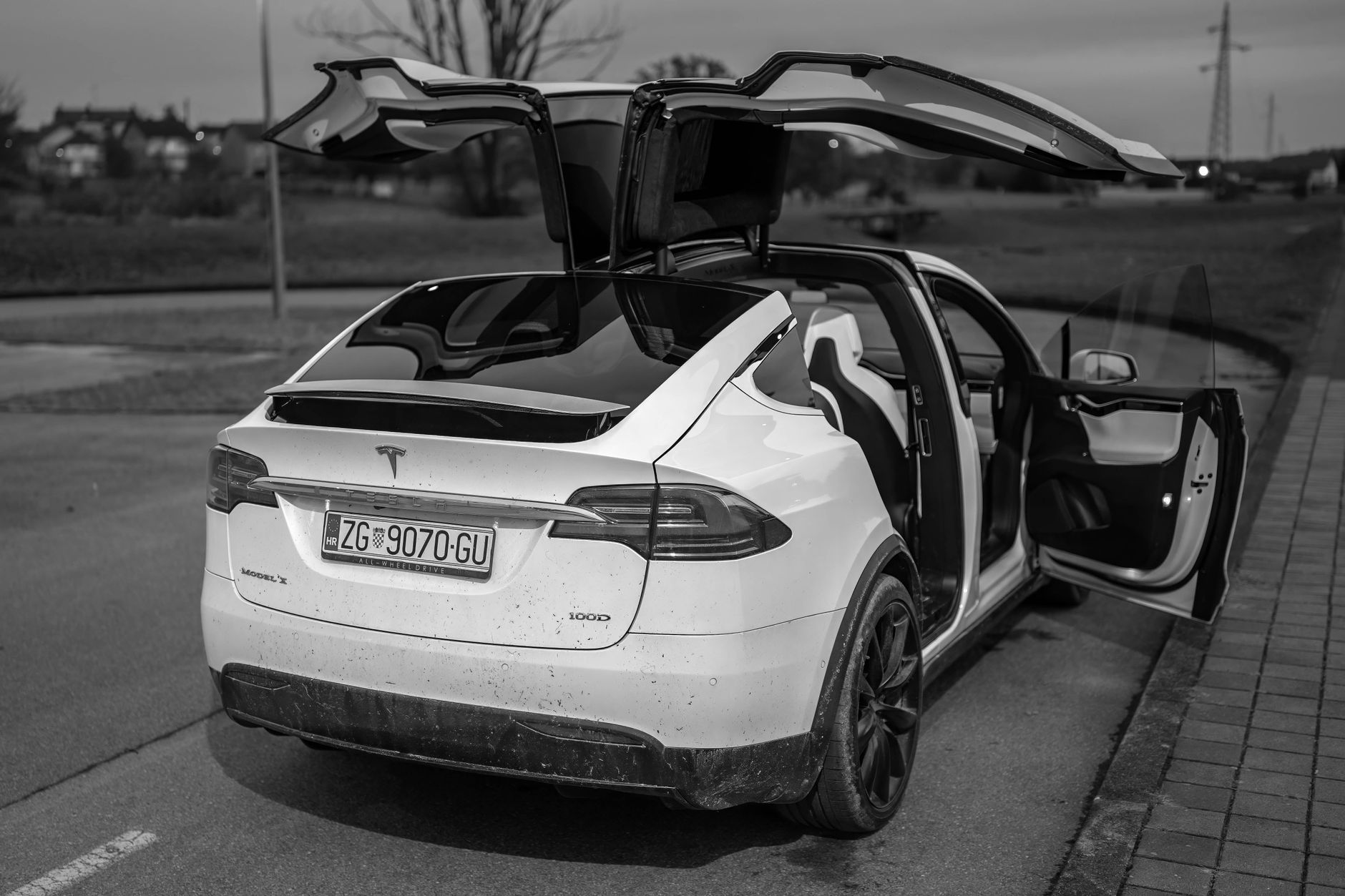
    Photo by Vladimir Srajber.
  • xAI All Hands: Scaling to 1 Million GPUs and the Roadmap to “Macro Hard”

    xAI All Hands: Scaling to 1 Million GPUs and the Roadmap to “Macro Hard”

    In a milestone “All Hands” meeting recorded in February 2026, Elon Musk and the xAI leadership team detailed the company’s meteoric rise and a fundamental reorganization designed to accelerate the path to AGI. In just two and a half years, xAI has transformed from a “toddler” startup into a leader in compute velocity and generative media.

    A Major Reorganization for Velocity

    To maintain what Musk calls “maniacal velocity,” xAI has reorganized into four specialized application pillars designed to handle the company’s massive scale [00:04:16]:

    • Grok Main & Voice: Focused on the core foundation model and high-performance, real-time voice agents [00:04:55].
    • Grok Code: A team dedicated to recursive self-improvement, where AI is used to train the next generation of coding models [00:09:40].
    • Imagine: The visual generation wing, which has scaled to industry-leading volume in record time [00:13:48].
    • Macro Hard: A futuristic project aimed at the digital emulation of entire corporations [00:16:59].

    Dominating the Generative Media Landscape

    The Imagine team reported staggering growth metrics that place xAI at the top of the leaderboard for visual content. Within six months of launch, the platform is now seeing:

    • 50 Million videos generated daily [00:13:48].
    • 6 Billion images generated per month—surpassing major competitors by nearly 6x in volume [00:14:04].

    The roadmap for Imagine includes real-time video rendering and the ability to generate 10–20 minute video sequences in a single shot by the end of the year [00:15:07].

    The Memphis Supercomputer: 1 Million GPUs

    xAI’s compute advantage is anchored by its massive facility in Memphis. The team revealed they are scaling from their initial 100,000 H100 cluster to one million H100 GPU equivalents [00:02:10].

    The facility is a marvel of vertical integration, featuring 847 miles of fiber per data hall and a power system supported by the world’s largest Tesla Mega Pack installation [00:32:24]. Musk noted that the speed at which xAI brings compute online is currently unmatched in the industry [00:34:27].

    The “Macro Hard” Vision: Emulating Digital Companies

    Perhaps the most ambitious project discussed was Macro Hard. Musk described this as the “emulation of entire human companies” where the output is purely digital [00:19:56]. By creating a fully capable digital human emulator, xAI intends to orchestrate complex tasks across engineering, law, and medicine, leading to what they describe as “immense economic prosperity” [00:18:36].

    X App: The Everything App Evolution

    The meeting also highlighted the continued evolution of the X app into a centralized communication and financial hub:

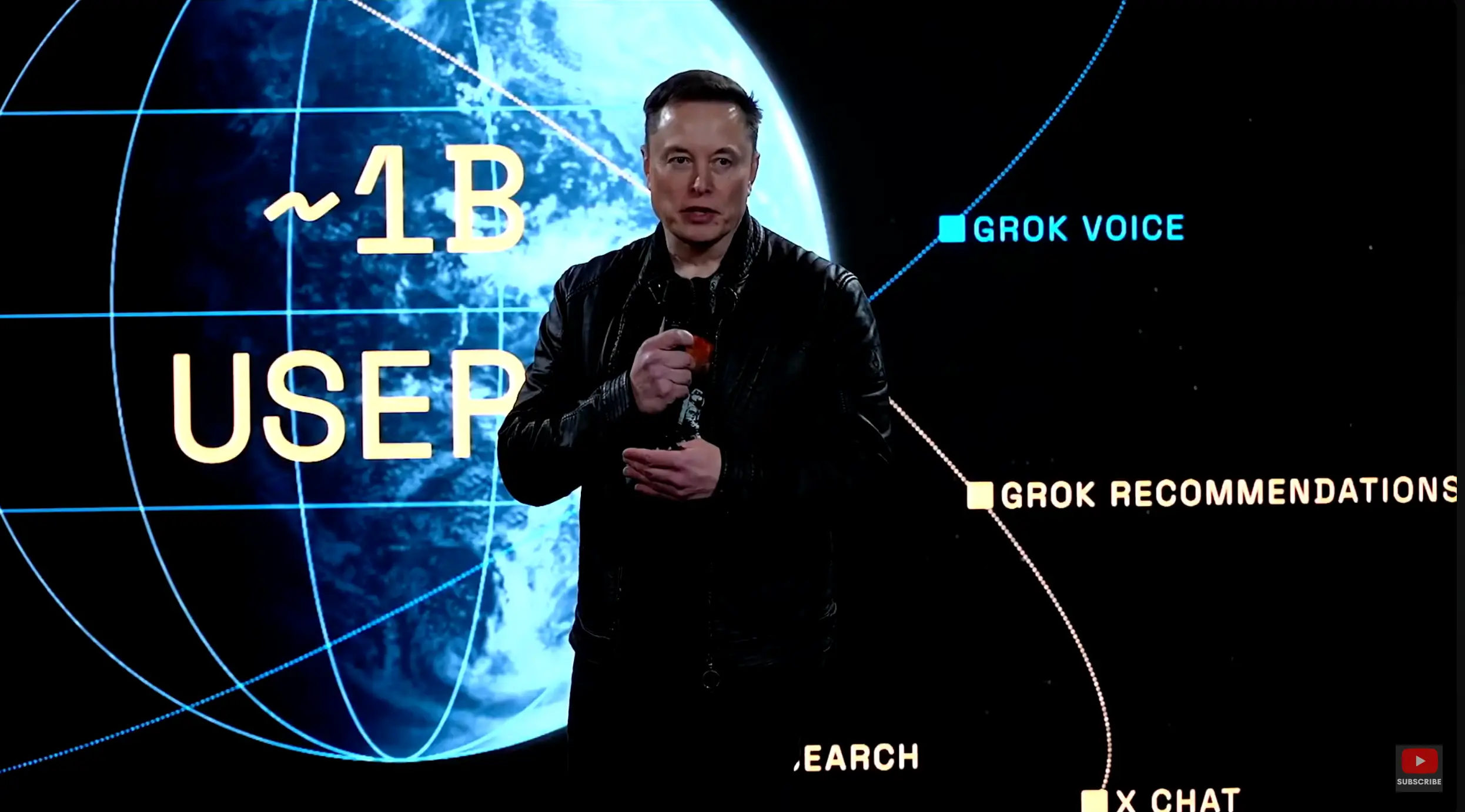
    • Financial Success: X has officially crossed $1 Billion in Annual Recurring Revenue (ARR) from subscriptions [00:38:04].
    • X Money: A central source for monetary transactions is currently in closed beta and moving toward a worldwide launch [00:40:14].
    • Open Source: Musk reiterated his commitment to transparency, promising to open-source the recommendation and chat algorithms [00:39:03].

    Beyond Earth: The Lunar Mass Driver

    In a final look at the “interstellar ambitions” of the company, Musk connected the dots between xAI and SpaceX. To truly understand the universe, Musk argues we must access the energy of the sun at a scale Earth cannot provide [00:43:04].

    The plan involves launching Orbital Data Centers at a rate of 100–200 gigawatts per year, eventually scaling to a Lunar Mass Driver—a lunar-based facility that would launch AI satellites into deep space to explore the galaxy [00:43:53].


    To learn more about joining the team or the technical specifics of the Memphis cluster, visit x.ai.