Blog

  • Tesla’s newest update expands blind-spot warning while parked, adds dashcam encryption and parental controls

    Tesla’s newest update expands blind-spot warning while parked, adds dashcam encryption and parental controls

    Tesla began rolling out software version 2026.20.6.1 to its fleet starting July 2, 2026, a quick follow-up patch built on the 2026.20.6 update that came before it. As of early July, the new version was still reaching cars in batches, according to rollout tracking site Teslascope, and it remains Tesla’s newest released version as of this writing, per Not a Tesla App’s running list of updates. The update does not add any major new driving features, but it changes several things that affect everyday ownership, including parking safety, dashcam privacy, and parental controls.

    The most safety-relevant change is a wider rollout of “Blind Spot Warning While Parked,” a feature meant to prevent so-called “dooring” accidents, where a driver or passenger opens a car door into the path of a passing cyclist, pedestrian, or vehicle. According to Tesla’s own release notes, when the system detects an approaching object while the car is parked, a chime sounds and the door will not open on the first press of the door button; occupants can override the warning by pressing again a moment later. Tesla also displays a visual warning: on cars with cabin ambient lighting, the door-side light strip turns red, and some models add a small red indicator light near the front pillar speaker grille, according to a report from Not a Tesla App. This update carries forward an expansion that brought the feature to the current Model Y and to 2021-or-newer Model S and Model X worldwide, adding to coverage that already included the Model 3 and Cybertruck, as reported by Teslarati. For an owner, this means the car may briefly resist opening a door if a bike or car is approaching from behind. That short delay is intentional, not a malfunction, and a second press will open the door regardless.

    The update also changes how dashcam footage is stored. Tesla’s cars continuously record from their external cameras, and owners can save clips to a USB drive for later viewing. Starting with this update, clips saved to USB are encrypted by default, meaning a saved clip can no longer simply be opened on any computer. To view or share a clip, an owner now needs to decrypt it first, either through the Dashcam app or at dashcam.tesla.com, according to Tesla’s release notes. Owners who prefer the previous behavior can turn encryption off from the touchscreen, under Controls, then Safety, then Encrypt Dashcam Recordings. The change mainly protects owners in the event a USB drive is lost or stolen, since dashcam footage can capture license plates, faces, and location information that owners may not want viewable by a stranger.

    A new parental-controls option lets an owner block the car’s Browser, Theater video-streaming app, and Arcade games entirely. The setting is turned on from Controls, then Safety, then Parental Controls, while the car is in Park, according to the same release notes. This gives parents or other primary drivers a way to keep those apps from being used from the driver’s or passenger’s seat at all, rather than relying on other family members to simply avoid them.

    Tesla’s in-car assistant, Grok, built by Elon Musk’s company xAI, also continues to expand under this software branch. The hands-free “Hey Grok” wake phrase lets an owner open the assistant by speaking, instead of tapping the screen or holding down the steering-wheel voice button, according to Tesla’s release notes. Tesla has separately been adding Grok to more countries in this same 2026.20 update series, including Chile, Malaysia, the Philippines, Thailand, Singapore, and Hong Kong, according to Not a Tesla App. Grok remains in early beta, and Tesla says it does not yet control car functions like climate or lighting; for now it mainly helps with navigation, including adding or editing destinations by voice command.

    Owners do not need to do anything to get 2026.20.6.1. Like all Tesla software, it downloads over Wi-Fi and installs automatically once the car is idle, and this same update cycle added the option to let updates install overnight on their own, according to Tesla’s release notes. Owners can check whether it has arrived by opening Controls, then Software, on the car’s touchscreen.

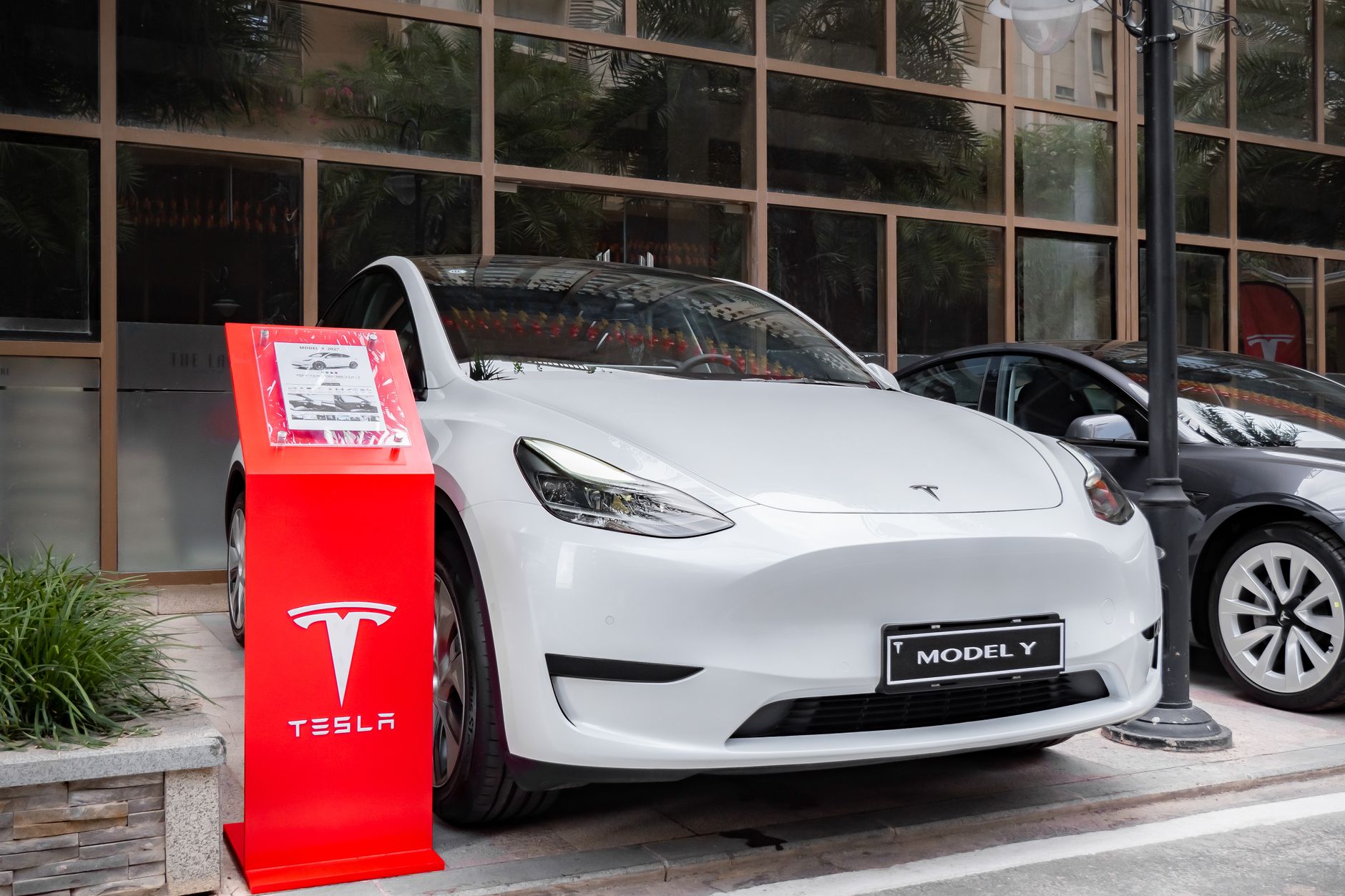
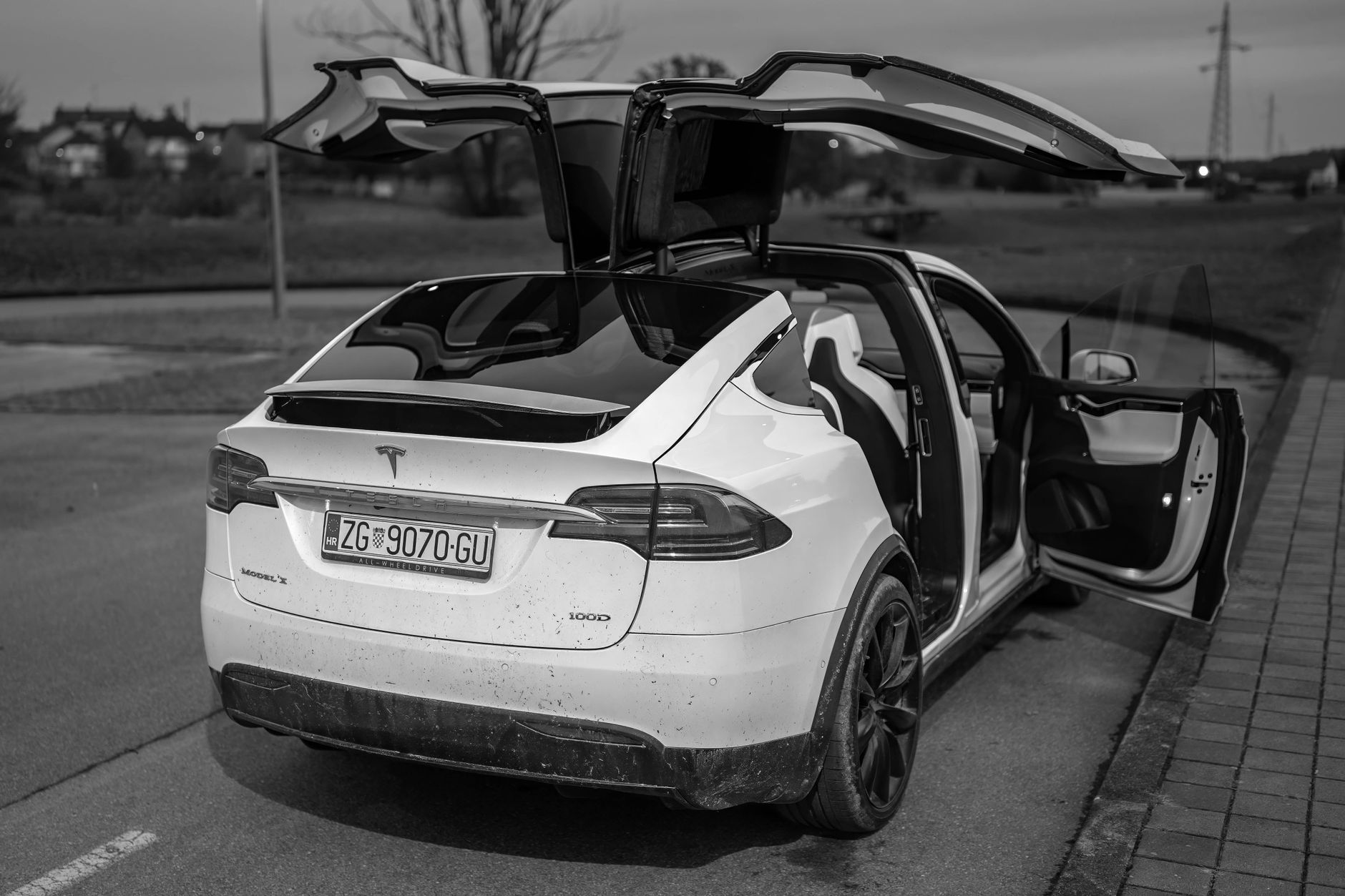
    Photo by Vladimir Srajber.
  • Model Y vs. Model X: Which Fits Your Family

    Model Y vs. Model X: Which Fits Your Family

    Model Y and Model X are both Tesla SUVs, but as of July 2026 they are not competing on equal footing. Tesla ended Model X production in spring 2026, while it keeps expanding the Model Y lineup, including a new six-seat long-wheelbase version. Here is how the two compare for a family shopping today.

    Model Y starts at $41,630 for the Standard rear-wheel-drive trim, including destination and order fees, and runs up to about $59,000 for the Performance trim, according to Kelley Blue Book’s 2026 spec sheet. Tesla just added a longer six-seat version called the Model Y L, which launched in the US on July 2, 2026 at $61,990. Model X is a different story. Tesla stopped building new Model X vehicles in spring 2026 and closed custom orders, so buyers can only choose from shrinking leftover inventory. Remaining units got a $15,000 price increase in April 2026, and InsideEVs reported Plaid inventory units priced near $129,900, with other remaining units starting around $111,000. If you want a new Tesla SUV you can actually order today, that effectively means Model Y.

    Seating is where the two vehicles diverge most. The standard Model Y seats five, with a tight optional third row that pushes capacity to seven. The new Model Y L addresses that complaint with a 2+2+2, six-seat layout built on a 5.9-inch-longer wheelbase, adding heated captain’s chairs and its own touchscreen for second-row passengers. Model X offers five, six, or seven-passenger configurations across three rows, and reviewers generally find its third row roomier and easier to reach than the standard Model Y’s, partly because of its rear falcon-wing doors, which swing up rather than out and can make loading car seats easier in tight garages or parking spots, though they close more slowly than a conventional door.

    On range, Model Y trims run from 321 miles (Standard) up to 357 miles (Premium RWD), with the Performance trim rated at 306 miles and the new Model Y L rated at 325 miles. Model X ranges from roughly 335 to 352 miles depending on trim.

    Cargo space favors Model X modestly: about 88 cubic feet behind the front row with the rear seats folded, plus a 6.5-cubic-foot front trunk, according to Recharged’s measurements. The two-row Model Y holds about 76 cubic feet with its seats folded, while the longer Model Y L holds about 89 cubic feet, per Electrek. Towing tells a similar story: Model X can pull up to 5,000 pounds with the factory tow package, versus 3,500 pounds for any Model Y, a figure that drops further on seven-seat Model Y configurations paired with larger wheels.

    For most families cross-shopping these two today, the decision is simpler than it looks. If you need three usable rows of seating in a brand-new Tesla, the Model Y L is your only current option, and it costs tens of thousands of dollars less than what remains of the Model X. If you specifically want the Model X’s extra cargo room, higher tow rating, or falcon-wing doors, you will be shopping the used or remaining new-inventory market rather than ordering one built to your specs, since Tesla is no longer manufacturing it.

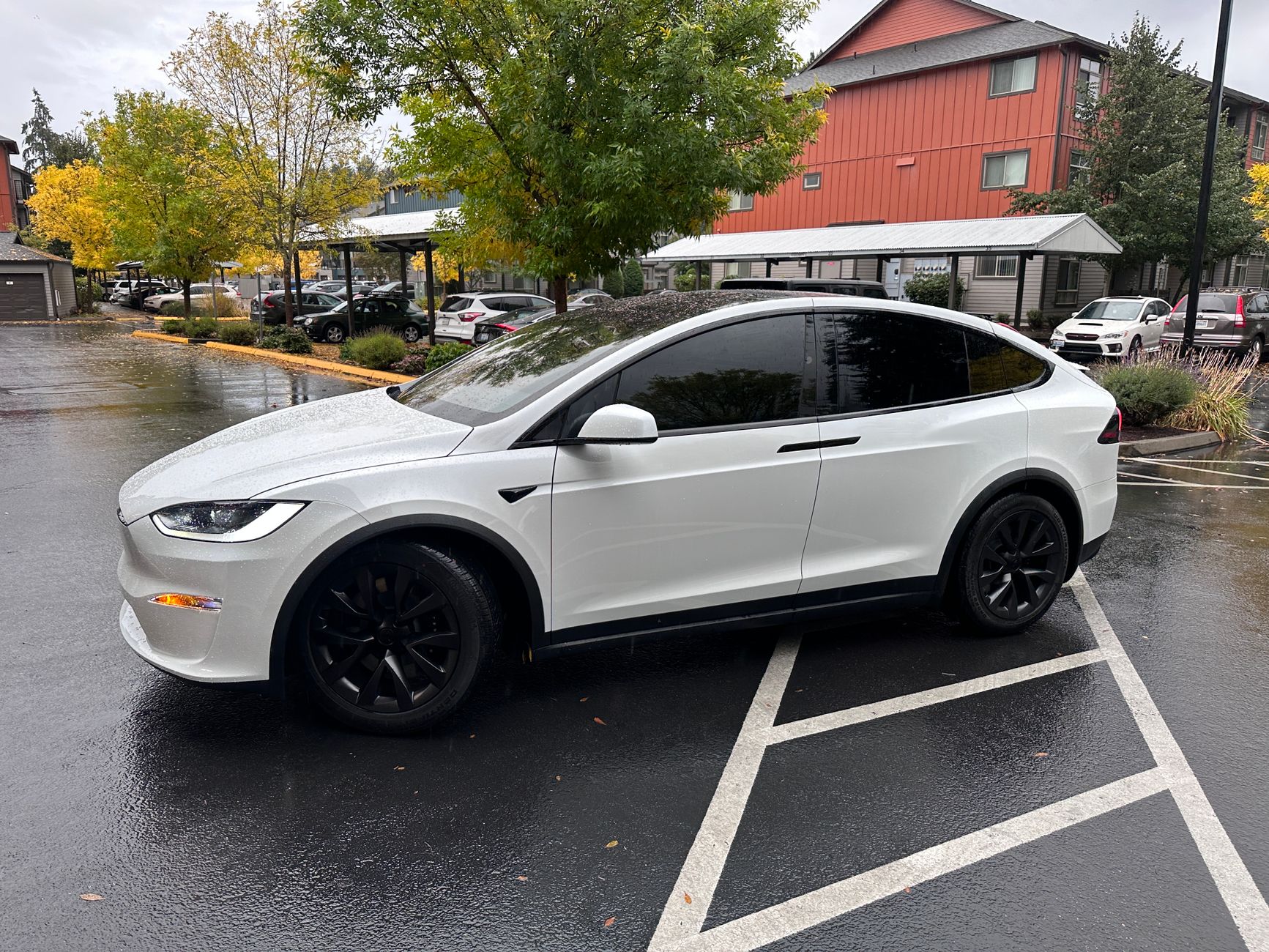
    Photo by dumitru B.

  • Buy these accessories in your first month.

    Buy these accessories in your first month.

    A new Tesla does not need much to be fully usable, but a handful of accessories solve real problems in the first few weeks. This guide sticks to categories that Tesla itself sells or that established EV outlets consistently recommend, not specific brands to buy.

    All-weather floor liners. Tesla’s carpet mats show wear and stains quickly, which is why the company sells its own all-weather interior liners through its shop. Electrek makes the same case for aftermarket sets: liners are easier to clean than carpet and reduce wear that can affect resale value later. Any set built specifically for your model and trim year does the job; the point is having one, not which brand you pick.

    A way to charge at home. Every Tesla ships with a Mobile Connector, which Tesla’s own support page lists as adding 4 to 6 miles of range per hour on a standard 120-volt household outlet, or 23 to 30 miles per hour on a 240-volt outlet, depending on the vehicle. For many owners who charge overnight, that is already enough. If you want faster, hands-off charging, Tesla’s Wall Connector adds up to 44 miles of range per hour at 11.5 kW (48 amps) on vehicles that support it, or up to 30 miles per hour on models capped at 32 amps, such as Model 3 and Model Y rear-wheel-drive versions. It costs $535 from Tesla and must be hardwired by a licensed electrician, so confirm you actually need the extra speed before buying one.

    A dedicated USB drive for Dashcam and Sentry Mode. Tesla’s built-in cameras only record once a USB drive is plugged in and formatted correctly. Tesla’s owner’s manual calls for at least 64 GB of storage, a sustained write speed of 4 MB/s or higher, and the exFAT format with a base-level folder named TeslaCam; the car can format a drive for you once it is plugged into the USB-A port in the glovebox. It is a small, inexpensive purchase that switches on a security feature that otherwise sits unused.

    A windshield sun shade. Tesla’s large windshield and glass roof let in more heat than a typical car, and outlets like Electrek recommend a heat shield or sunshade for that reason, both to keep the cabin cooler after parking in the sun and to limit UV exposure on the dashboard and trim over time.

    A portable tire inflator. Tire pressure affects range and tire wear, and Electrek flags a portable air compressor as worth keeping in the frunk so you can check and correct pressure without a stop at a gas station. That matters more on an EV, where an underinflated tire has a more noticeable effect on efficiency.

    A backup key card. By default, your phone is your Tesla’s key, connecting over Bluetooth, as described on Tesla’s vehicle keys support page. A dead phone battery or a software glitch can lock you out, which is why Tesla sells a Key Card two-pack with a bifold wallet for $40. It is a cheap way to make sure you are never stuck outside your own car.

    None of this requires spending much in the first month. Match each category to how you actually use the car: someone who parks in a garage can skip the sun shade, and someone who charges mostly at work may not need a Wall Connector at all.

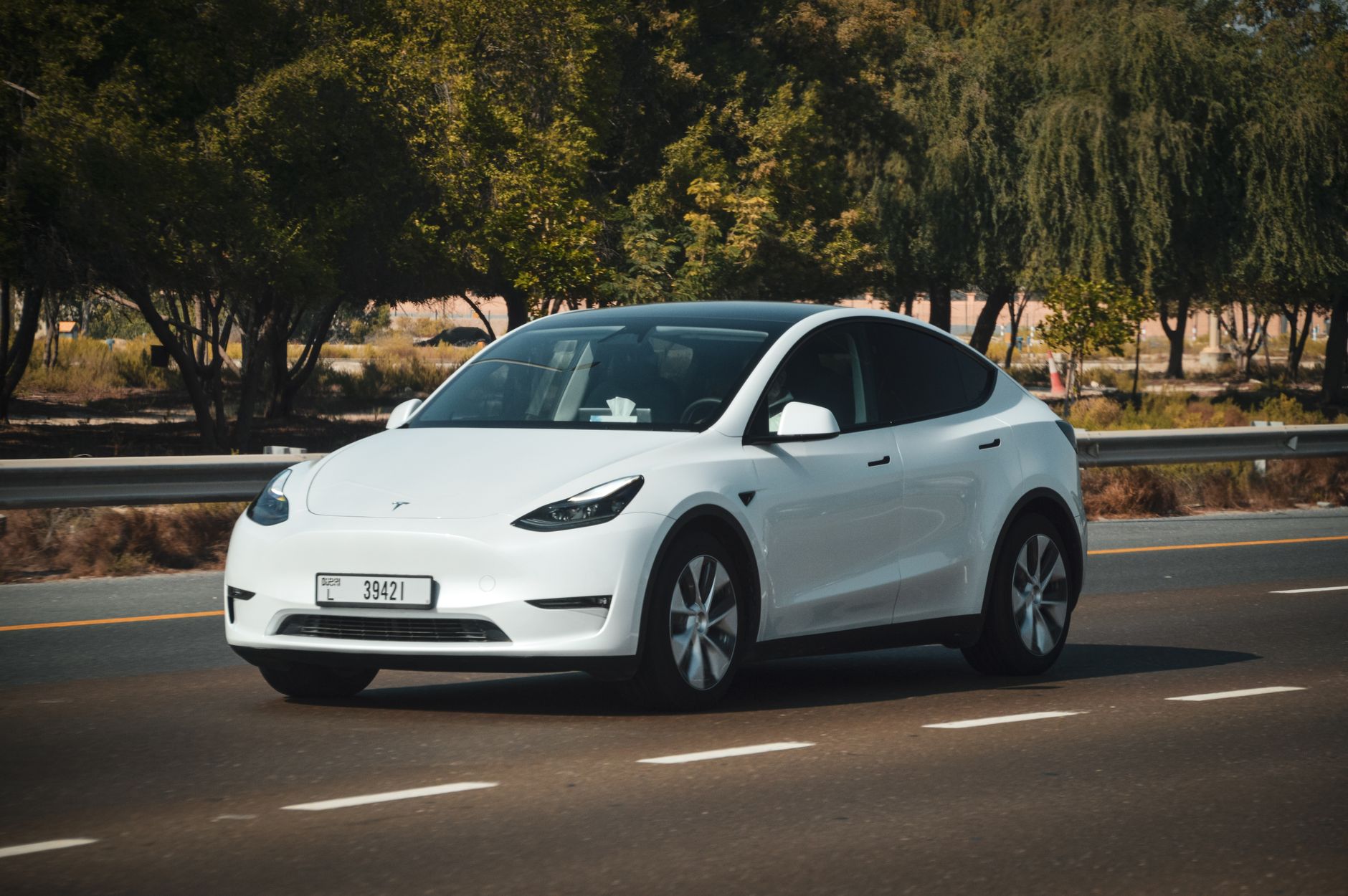
    Photo by Makara Heng.

  • Inspect Your Tesla Before You Accept Delivery

    Inspect Your Tesla Before You Accept Delivery

    Before you sign for your Tesla and drive it off the lot, walk around the car and check it carefully. Once you accept delivery, it becomes harder to prove that a scratch, a loose trim piece, or a chip in the glass was there when you picked up the car rather than something that happened afterward.

    Start with the paperwork. Tesla has you submit insurance information, final payment, and identification through the app before your delivery appointment, and asks you to bring your driver’s license, insurance, and any trade-in documents so they can be matched against your order. At the vehicle, confirm the VIN matches that paperwork. Tesla’s own warranty documentation notes that the VIN is stamped on the upper dashboard, driver’s side, and is visible through the windshield.

    Walk the exterior in daylight. Look at panel gaps around the hood, doors, trunk, and charge port for consistency, and check the paint for scratches, swirl marks, or uneven color. Check every window and the windshield for chips or cracks. This matters beyond looks: Tesla’s new vehicle warranty excludes windshield or window glass that is broken, chipped, scratched, or cracked, unless it resulted from a defect in Tesla’s material or workmanship, so any glass damage you spot needs to be on record before you leave.

    Check the tires next. Look at tread depth and condition on all four. Tires are not covered by Tesla’s vehicle warranty; the same document states that tires have their own warranties and are subject to their own terms and conditions, so a tire issue is between you and the tire manufacturer, not Tesla.

    Inside, open and close every door, the trunk, and the frunk, and check that interior trim panels sit flush and don’t rattle. Test the seats, seatbelts, mirrors, and all interior and exterior lights, including turn signals and brake lights.

    On the touchscreen, confirm it boots up and responds normally. Tesla recommends reviewing “Meet Your Tesla” and your car’s software update information before you leave, and notes that you can tap “Service” on the touchscreen after delivery to reach the digital owner’s manual. Check the odometer too; a new vehicle’s reading should reflect only the mileage added during manufacturing, transport, and any test drives at the delivery center.

    Confirm what charging equipment came with your car. Tesla states plainly that charging equipment does not come standard with every Tesla vehicle, so check your order details against what is actually in the trunk or frunk before you drive away.

    If you find a problem, write it down on the delivery paperwork and photograph it before you sign. Your Tesla New Vehicle Limited Warranty coverage begins on the first day the vehicle is delivered, and to get anything fixed afterward, you contact Tesla and provide the VIN, current mileage, and a description of the defect. The signed delivery paperwork becomes available afterward in your Tesla Account, under “Manage” and then “Documents”, but a defect noted and photographed at delivery is easier to resolve than one reported after you have already been driving the car. Report anything you find right away, rather than waiting until you get home.

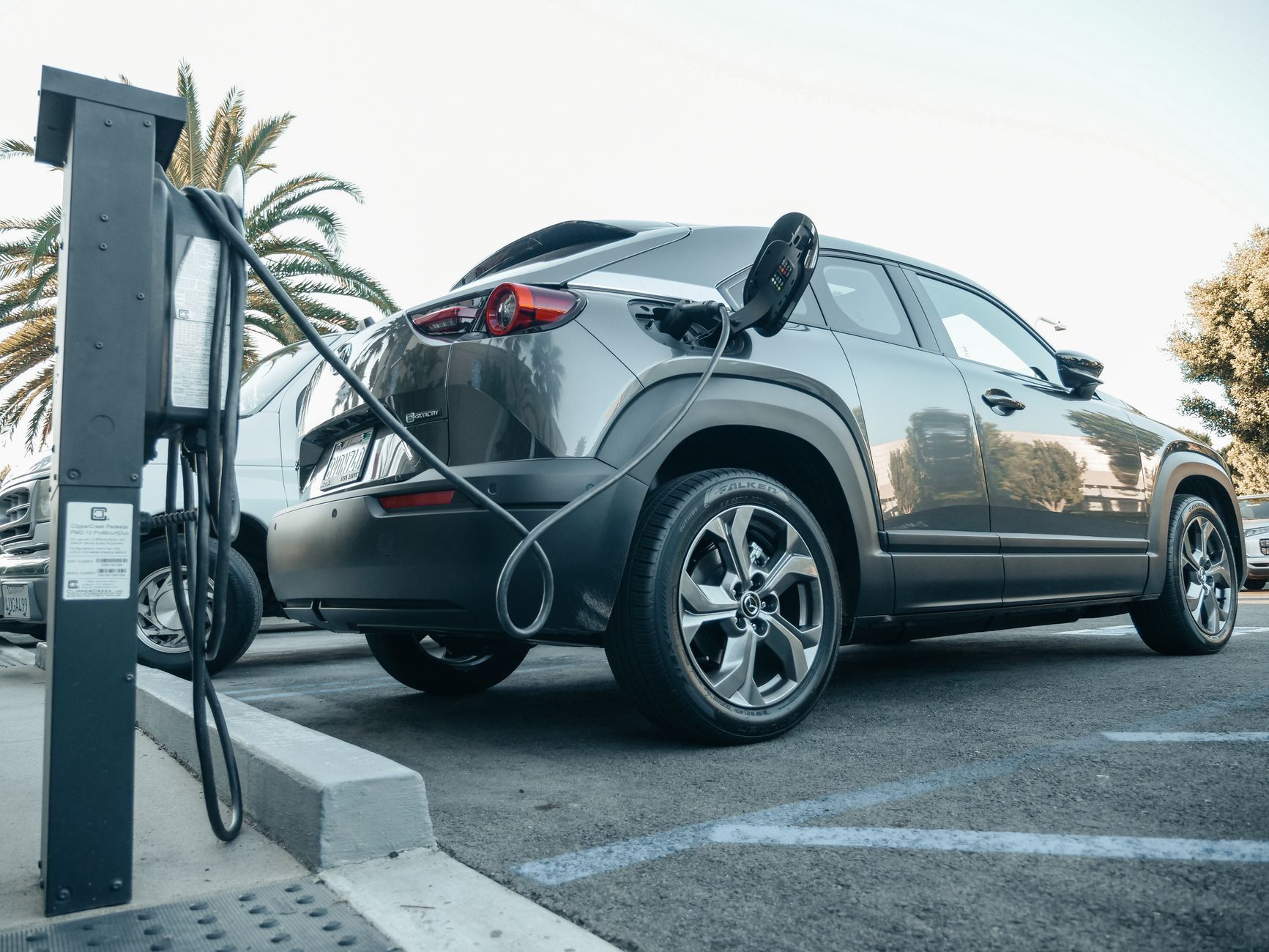
    Photo by Reinaldo Simoes.

  • Plan your first Tesla road trip this summer.

    Plan your first Tesla road trip this summer.

    Summer is peak road-trip season, and a Tesla makes long-distance driving easier than most people expect, as long as you understand two things going in: how the car plans your charging stops, and how much range you actually get once you’re holding highway speed. Here’s what a first-time Tesla road-tripper needs to know before pulling out of the driveway.

    Let the car plan your route

    You don’t need a third-party app to plan a Tesla road trip. Type your destination into the touchscreen, and Navigation identifies the fastest route along with the most convenient places to charge along the way. If your trip is long enough to require a charge, Trip Planner automatically builds Supercharger stops into your turn-by-turn directions, showing a recommended charging time at each stop and how much battery you’ll have when you arrive. The estimates update as you drive, accounting for real-time traffic, weather, and elevation change, and the car starts warming or cooling the battery before you reach a Supercharger so it’s ready to accept a faster charge the moment you plug in.

    You’re not locked into whatever the car suggests. You can remove a Supercharger stop from your route, and navigation also shows charging options at hotels, restaurants, and shopping centers if you’d rather charge somewhere with more to do while you wait, according to Tesla’s own travel-planning guidance.

    How big the Supercharger network is right now

    The scale of the network is a big reason Tesla road trips have gotten less stressful over the years. Tesla says it operates more than 80,000 Superchargers worldwide, and tracking of Tesla’s own quarterly data puts the total at roughly 79,900 charging stalls across more than 8,460 stations globally as of the first quarter of 2026, with U.S. locations alone topping 3,000 stations. The network grew about 19% year over year in that period, so new stations keep filling in gaps along popular routes. In practice, most interstates in the U.S. now have Superchargers spaced closely enough that you’re rarely far from one, even in less-traveled corridors.

    How fast you can actually charge

    Charging speed depends on your car, the specific stall, and how full your battery already is. By Tesla’s own figures, a Model 3 can add up to 175 miles of range in 15 minutes, a Model Y up to 162 miles, and a Model S up to 200 miles, under ideal conditions. Newer “V4” Supercharger stalls can push more power to vehicles built for it, up to 325 kilowatts as of January 2025, but current Model 3, Model Y, Model S, and Model X vehicles still cap out around 250 kW because of how their battery packs are built, so plugging into a newer stall won’t necessarily speed up your specific car.

    Charging also isn’t a flat rate the whole way. Your car pulls power fastest when the battery is low, and Tesla may automatically cap your charge limit at 80% at busy Supercharger locations to reduce congestion. That’s part of why the practical road-trip strategy is to charge to around 80% and get back on the road, rather than waiting around for a full battery.

    Your real range on the highway

    The range number on your car’s window sticker is an EPA combined estimate, and it leans toward city driving, where EVs are most efficient. Sustained highway speed tells a different story. Tesla’s own guidance notes that doubling your speed can require up to four times as much energy per mile, because aerodynamic drag rises sharply as you go faster. Independent testing backs this up: a widely cited 2023 study built on Car and Driver’s steady 75-mph highway test found the average EV fell about 12.5% short of its EPA-rated range, while gasoline vehicles in the same test actually beat their window-sticker numbers by about 4%.

    The takeaway: don’t plan a trip assuming you’ll get the full EPA number between charges. Budget for meaningfully less once you’re holding 75-80 mph on the interstate, and let Trip Planner’s live, in-car estimates, which account for your actual speed, elevation, and weather, guide your stops rather than the spec-sheet figure.

    How to cut down on charging stops and time

    A few habits make a real difference in total trip time:

    • Check tire pressure before you leave. Underinflated tires increase rolling resistance and hurt range, according to Tesla’s range guidance.
    • Take off roof racks or bike carriers you’re not using. Anything that adds drag costs you range at highway speed, per the same Tesla guidance.
    • Close the windows and keep cargo weight down for the same reason; both are on Tesla’s list of range-maximizing habits.
    • Set regenerative braking to Standard to conserve range during deceleration, a setting Tesla specifically recommends for road trips.
    • Charge to around 80%, not 100%, at Supercharger stops. Since Tesla’s own system already leans on 80% as a practical charge target at busy stations, treat it as your default too and get back on the road instead of topping off slowly.
    • Navigate to the Supercharger instead of just typing in the address separately, so the car preconditions the battery and it’s warm and ready to accept a fast charge when you arrive.
    • Watch the Energy app, not the range estimate, for a real-time read on how your speed and driving style affect consumption.

    None of this requires special planning software or a lot of EV experience. Type in your destination, let Trip Planner build the route, budget for highway range that runs meaningfully below the window-sticker number, and treat each Supercharger stop as a 15-to-25-minute break rather than a full recharge. For most summer trips within a few hundred miles of home, that’s really all the planning a first-time Tesla road-tripper needs.

    Photo by Saksham Vikram.

  • The $7,500 federal tax credit is gone. Here’s what still helps in 2026.

    The $7,500 federal tax credit is gone. Here’s what still helps in 2026.

    If you’re shopping for a Tesla in July 2026, plan your budget without the $7,500 federal tax credit. It’s gone. Congress ended the New Clean Vehicle Credit, the Previously-Owned Clean Vehicle Credit, and the Commercial Clean Vehicle Credit for any vehicle acquired after September 30, 2025, according to the IRS’s own clean vehicle tax credit page. The cutoff came from the One Big Beautiful Bill Act, which Tesla’s incentives page notes was signed on July 4, 2025 and moved up the credit’s expiration by several years.

    There is one narrow exception. If you signed a binding purchase contract and made a payment on or before September 30, 2025, you may still be able to claim the credit on your tax return even if the car was delivered later, per IRS guidance. For anyone buying now, that window has closed, and no new federal purchase credit has replaced it.

    A smaller federal break: loan interest, not a purchase credit

    The same law created a consolation prize: a deduction for interest paid on new-vehicle loans. You can deduct up to $10,000 a year in car loan interest, according to IRS guidance on the new deduction. It applies to loans that originated after December 31, 2024, and it’s a deduction (it lowers your taxable income), not a credit that cuts your tax bill dollar for dollar, so the real-world savings are smaller than the number suggests.

    There are catches worth knowing before you count on it. Per Tesla’s own summary of the rule, the vehicle must be new, weigh under 14,000 pounds, and have its final assembly point in the United States — Tesla’s Model 3, Y, S, and X are built in Fremont, California, or Austin, Texas, so they generally qualify. The deduction also phases out for individuals with modified adjusted gross income over $100,000 (or $200,000 for joint filers), used vehicles and leases don’t count, and you’ll need to itemize using a new IRS schedule to claim it.

    The home charger credit already expired

    If you were also counting on a tax break for installing a home charger, that window has just closed. The federal Alternative Fuel Vehicle Refueling Property Credit, which covered 30% of hardware and installation costs up to $1,000, was only available for chargers placed in service through June 30, 2026, according to the IRS page on the credit. As of this writing, that deadline has already passed, and the credit is no longer available for new installations.

    State incentives: what’s left is a patchwork, and it changes fast

    With federal purchase credits gone, state and utility programs matter more than ever, but they vary enormously by where you live, and several have run out of money mid-year. A few examples as of July 2026:

    California’s Clean Vehicle Rebate Project, once worth up to $7,500, stopped accepting new applications back in November 2023 and has not reopened, per the Clean Vehicle Rebate Project’s own site. Lower-income California buyers may still have options through separate programs like Clean Cars 4 All, but the broad rebate most Tesla buyers used is closed.

    Colorado still offers a state tax credit for new EVs: $750 for vehicles with an MSRP up to $80,000, with an added $2,500 for vehicles priced under $35,000, according to the Colorado Energy Office. Because most Tesla models list above $35,000, most Tesla buyers there would only qualify for the smaller $750 credit.

    Massachusetts runs the MOR-EV rebate program, offering $3,500 toward eligible new EVs, but only if the vehicle’s total MSRP stays under $55,000, per MOR-EV’s eligibility page. That cap rules out higher trims and pricier Tesla models.

    Illinois pays a $2,000 rebate for a new or used EV (up to $4,000 for lower-income applicants) on vehicles priced at $80,000 or less, but the state’s Illinois EPA rebate program closed its FY2026 application cycle on May 31, 2026, after funding ran out.

    New Jersey used to waive its entire 6.625% sales tax on EVs, but that exemption was phased out, and as of July 1, 2025 EVs are fully taxable there, according to the New Jersey Division of Taxation. Oregon’s popular Clean Vehicle Rebate Program has suspended new applications due to funding shortfalls and does not expect to reopen until later in 2026, per the Oregon Department of Environmental Quality.

    The pattern across states is the same: programs exist, but budgets are limited, rules change through the year, and many close their application windows once funds run out. Beyond direct rebates, some states and utilities also offer non-cash perks like carpool-lane access or reduced registration fees, and many utilities have their own rebates for home charging equipment, which Tesla’s incentives page directs buyers to check directly with their utility provider.

    What this means for your total cost of ownership

    The math on owning a Tesla has shifted. Where buyers in prior years could often plan around $7,500 in guaranteed federal savings, that’s no longer a safe assumption for a 2026 purchase. Instead, your actual savings now depend heavily on your state, your income, your loan terms, and whether a given program still has funding when you buy. Before you sign anything, check your state energy office’s website and your electric utility’s rebate page directly, since third-party estimates can lag behind program closures and funding changes. Factor in only the incentives you can confirm are currently active and that you’re eligible for, rather than the $7,500 figure many buyers still remember from prior years.

    This article is for general information only and is not tax advice. Incentive programs, eligibility rules, and funding availability change often — confirm current details with the IRS, your state’s energy office, and a qualified tax professional before making purchase decisions.

    Photo by Kindel Media.

  • Tesla Q2 2026 delivery numbers: what owners should know.

    Tesla Q2 2026 delivery numbers: what owners should know.

    Tesla delivered 480,126 vehicles worldwide in the second quarter of 2026, according to the company’s official production and delivery report published July 2. It’s the best second quarter in the company’s history and the first year-over-year delivery increase after two straight years of decline.

    Tesla produced 451,758 vehicles during the quarter and delivered more than it built, which means the company worked down roughly 28,000 vehicles of existing inventory rather than adding to it, according to Electrek’s analysis of the report. That reverses a buildup of about 50,000 excess vehicles that had accumulated in the first quarter of 2026.

    How this compares to expectations

    Deliveries came in about 74,000 vehicles above the average Wall Street forecast, which had called for roughly 406,000 deliveries, per Electrek’s pre-report consensus tracking. Even the most optimistic analyst estimates, in the 418,000-to-420,000 range, fell well short of the actual number. Deliveries were also up 25% from the same quarter last year, when Tesla delivered 384,122 vehicles — and this quarter’s total is the second-highest of any quarter in company history, trailing only the 497,099 vehicles delivered in the third quarter of 2025.

    The Model 3 sedan and Model Y SUV accounted for 467,762 of the quarter’s deliveries. The remaining 12,364 covers the Model S, Model X, Cybertruck, and Semi combined. Tesla doesn’t break out delivery figures by individual model beyond the Model 3/Y grouping in its quarterly reports.

    What’s behind the jump

    The comparison is notable because it isn’t riding the same tailwind as last year. Q2 2025 deliveries were inflated by a rush of buyers trying to close deals before the US federal EV tax credit and similar rebate programs in other countries expired, which made this year’s growth, arriving without that same incentive push, more of a demand signal than the raw percentage alone suggests.

    Coverage from Yahoo Finance points to a few concrete factors instead: Tesla introduced lower-priced variants of the Model 3 and Model Y earlier this year, expanded its Full Self-Driving (Supervised) software into additional European markets, and saw a bump in European demand tied to a spike in fuel costs during the quarter. None of that changes what you pay for a Tesla today, but it helps explain where the extra volume came from.

    Tesla shares actually fell after the report — down roughly 7.5% on the day, per the same Yahoo Finance coverage — a reminder that a single quarter’s delivery beat doesn’t map cleanly onto stock performance, and isn’t something that should factor into an ownership decision either way.

    Energy storage grew too

    Tesla’s energy storage business — the Powerwall and Megapack products — deployed 13.5 GWh of storage in the quarter, up 40% from 9.6 GWh a year earlier. That’s a smaller beat than the vehicle side: it came in slightly below the roughly 13.8 GWh analysts had expected.

    What it means if you own or are ordering a Tesla

    A quarter where Tesla delivers more cars than it builds is generally good news if you’re waiting on a new order: it suggests the company is working through existing inventory rather than letting a backlog grow, which historically correlates with more predictable delivery windows rather than longer ones. It doesn’t tell you anything directly about pricing or incentives — those are set separately, change independently of delivery reports, and are worth confirming directly on Tesla’s order pages before you buy.

    If the lower-priced Model 3 and Model Y variants mentioned above are part of what drove this quarter’s numbers, it’s a good sign that Tesla is actively working the price end of the lineup — worth checking current configurator pricing if a more affordable trim is what’s been holding you back from ordering.

    For current owners, strong delivery and energy deployment numbers are one input, among many, into the broader health of the company that built your car and, if you have one, your Powerwall or home charging setup. But a single quarter’s delivery count isn’t a signal about your vehicle’s warranty, service network, or software support, which are governed separately and haven’t changed as a result of this report.

    Tesla is scheduled to release full second-quarter financial results on July 22, 2026, which will include more detail on margins, energy business profitability, and forward guidance than the delivery report alone covers. Its next production-and-delivery report will cover the third quarter and typically arrives in the first few days of October.

    One more data point worth keeping in perspective: this quarter also beat Tesla’s previous Q2 record of 466,140 vehicles, set back in 2023, by roughly 14,000 units. Combined with the swing from a 50,000-vehicle inventory buildup in Q1 to a 28,000-vehicle drawdown in Q2, the numbers suggest Tesla matched production more closely to actual demand this quarter than it had in the recent past — which, if it holds, is generally the kind of trend that supports steadier delivery timelines for new orders rather than the swings buyers have sometimes seen around quarter-end pushes.

    Photo by Craig Adderley.

  • xAI All Hands: Scaling to 1 Million GPUs and the Roadmap to “Macro Hard”

    xAI All Hands: Scaling to 1 Million GPUs and the Roadmap to “Macro Hard”

    In a milestone “All Hands” meeting recorded in February 2026, Elon Musk and the xAI leadership team detailed the company’s meteoric rise and a fundamental reorganization designed to accelerate the path to AGI. In just two and a half years, xAI has transformed from a “toddler” startup into a leader in compute velocity and generative media.

    A Major Reorganization for Velocity

    To maintain what Musk calls “maniacal velocity,” xAI has reorganized into four specialized application pillars designed to handle the company’s massive scale [00:04:16]:

    • Grok Main & Voice: Focused on the core foundation model and high-performance, real-time voice agents [00:04:55].
    • Grok Code: A team dedicated to recursive self-improvement, where AI is used to train the next generation of coding models [00:09:40].
    • Imagine: The visual generation wing, which has scaled to industry-leading volume in record time [00:13:48].
    • Macro Hard: A futuristic project aimed at the digital emulation of entire corporations [00:16:59].

    Dominating the Generative Media Landscape

    The Imagine team reported staggering growth metrics that place xAI at the top of the leaderboard for visual content. Within six months of launch, the platform is now seeing:

    • 50 Million videos generated daily [00:13:48].
    • 6 Billion images generated per month—surpassing major competitors by nearly 6x in volume [00:14:04].

    The roadmap for Imagine includes real-time video rendering and the ability to generate 10–20 minute video sequences in a single shot by the end of the year [00:15:07].

    The Memphis Supercomputer: 1 Million GPUs

    xAI’s compute advantage is anchored by its massive facility in Memphis. The team revealed they are scaling from their initial 100,000 H100 cluster to one million H100 GPU equivalents [00:02:10].

    The facility is a marvel of vertical integration, featuring 847 miles of fiber per data hall and a power system supported by the world’s largest Tesla Mega Pack installation [00:32:24]. Musk noted that the speed at which xAI brings compute online is currently unmatched in the industry [00:34:27].

    The “Macro Hard” Vision: Emulating Digital Companies

    Perhaps the most ambitious project discussed was Macro Hard. Musk described this as the “emulation of entire human companies” where the output is purely digital [00:19:56]. By creating a fully capable digital human emulator, xAI intends to orchestrate complex tasks across engineering, law, and medicine, leading to what they describe as “immense economic prosperity” [00:18:36].

    X App: The Everything App Evolution

    The meeting also highlighted the continued evolution of the X app into a centralized communication and financial hub:

    • Financial Success: X has officially crossed $1 Billion in Annual Recurring Revenue (ARR) from subscriptions [00:38:04].
    • X Money: A central source for monetary transactions is currently in closed beta and moving toward a worldwide launch [00:40:14].
    • Open Source: Musk reiterated his commitment to transparency, promising to open-source the recommendation and chat algorithms [00:39:03].

    Beyond Earth: The Lunar Mass Driver

    In a final look at the “interstellar ambitions” of the company, Musk connected the dots between xAI and SpaceX. To truly understand the universe, Musk argues we must access the energy of the sun at a scale Earth cannot provide [00:43:04].

    The plan involves launching Orbital Data Centers at a rate of 100–200 gigawatts per year, eventually scaling to a Lunar Mass Driver—a lunar-based facility that would launch AI satellites into deep space to explore the galaxy [00:43:53].


    To learn more about joining the team or the technical specifics of the Memphis cluster, visit x.ai.

  • The Future of Intelligence: Key Takeaways from Elon Musk’s Vision for AI and Robotics

    The Future of Intelligence: Key Takeaways from Elon Musk’s Vision for AI and Robotics

    In a wide-ranging interview with Dwarkesh Patel, Elon Musk detailed a future defined by a “maniacal sense of urgency.” From moving AI compute into space to the recursive exponential growth of humanoid robots, Musk’s roadmap focuses on identifying and crushing the “limiting factors” of human progress.

    1. Space-Based AI: Solving the Earthly Power Crisis

    One of the most provocative predictions Musk made is that within 36 months, space will become the most economically compelling location for AI data centers. The reasoning is rooted in physics and resource availability:

    • The Electricity Bottleneck: While chip production is growing exponentially, Earth’s power grid is relatively stagnant. Space offers an untapped frontier for energy.
    • Solar Efficiency: Without an atmosphere, day/night cycles, or weather interference, solar panels in space are roughly five times more effective than those on the ground.
    • Battery-Free Operations: By operating in constant sunlight, space-based AI avoids the massive infrastructure costs of the batteries required to power Earth-based centers at night.

    2. Optimus and the “Infinite Money Glitch”

    Musk views the Tesla Optimus humanoid robot not just as a tool, but as a fundamental shift in the global economy. He refers to it as an “infinite money glitch” because of its ability to eventually manufacture more versions of itself.

    This growth is driven by three “recursive exponentials”:

    1. Digital intelligence.
    2. Chip capability.
    3. Electromechanical dexterity.

    Tesla has transitioned to a “physics first” approach, even designing custom actuators in-house to achieve human-level hand dexterity. The ultimate goal is mass production reaching one million units per year by Optimus Version 3.

    3. Scaling Beyond Limits: The “Terapab” Initiative

    To support the massive compute requirements of the next decade, Musk introduced the concept of Terapab—a massive manufacturing initiative designed to bypass current supply chain backlogs. He anticipates that SpaceX and Tesla may eventually need to build their own dedicated “fabs” to produce millions of wafers for logic and memory chips every month.

    4. xAI: Understanding the Universe Through Truth

    The mission of xAI and its flagship model, Grok, is defined simply: “understanding the universe.” Musk argues that for an AI to be safe and useful, it must be rigorously truth-seeking.

    He warns against the dangers of “politically correct” AI, citing 2001: A Space Odyssey to illustrate how forcing an AI to lie can lead to a breakdown in its logic. By focusing on understanding the universe, Musk believes AI will naturally find humanity interesting and seek to preserve human consciousness.

    5. “Pico-Management” and the Art of the Pivot

    Musk described his leadership style as “pico-management.” Rather than managing every detail, he drills down into specific, minute problems only when they represent the primary limiting factor for the entire company. A prime example of this was the pivot from carbon fiber to stainless steel for Starship—a decision made to increase the speed of development and improve material performance at cryogenic temperatures.


    Watch the Full Interview

    For more insights on management philosophy, hiring for “goodness of heart,” and the future of Starship, watch the full conversation below:

    Elon Musk Interview – Dwarkesh Patel

  • Tesla Q4 & FY 2025: The Dawn of the Physical AI Era

    Tesla Q4 & FY 2025: The Dawn of the Physical AI Era

    Tesla’s 2025 update is more than just a financial report—it marks the definitive turning point in our mission. While we continue to deliver world-class electric vehicles, 2025 was the year we fundamentally transitioned from a hardware-centric company to a physical AI company.

    From the launch of unmonitored Robotaxis to the announcement of our next-generation Optimus design, here is the breakdown of how we are building the future of autonomous intelligence.


    2025: A Critical Year of Transition

    In 2025, we balanced a maturing automotive market with massive leaps in AI infrastructure and robotics.

    Financial Highlights

    • Total Revenues: Reached $94.8 billion for the full year.
    • Operating Income: Achieved $4.4 billion in GAAP operating income.
    • Cash Strength: Our cash, cash equivalents, and investments grew to $44.1 billion, providing the liquidity needed to fund our ambitious roadmap.
    • Energy Storage: A standout performer with a record 46.7 GWh deployed in 2025—a 49% increase year-over-year.

    Operational Milestones

    We hit major production milestones across our global Gigafactories:

    • 9 Millionth Vehicle: Produced globally at Gigafactory Shanghai.
    • 6 Millionth Drive Unit: Produced at Gigafactory Nevada.
    • Model Y Refresh: Completed the refresh of our vehicle lineup with the launch of the new Model Y, including additional variants.

    The AI Roadmap: Scaling Autonomy

    Our vertical integration allows us to optimize AI at the system level—from the silicon up.

    Robotaxi & FSD

    • Unsupervised Rides: In January 2026, we began removing safety monitors from Robotaxis in Austin on a limited basis.
    • Rapid Expansion: Robotaxi coverage is slated to expand to Dallas, Houston, Phoenix, Miami, and more in the first half of 2026.
    • FSD (Supervised) v14: Our latest software uses end-to-end foundation models to handle complex “corner cases” that handle diverse geographies.

    Next-Gen Hardware

    • Optimus Gen 3: We are unveiling the Gen 3 Optimus in Q1 2026, featuring a design intended for mass production.
    • AI5 & AI6 Chips: Our in-house autonomy chips are progressing toward production in 2027 and 2028, targeting a 50x performance improvement over current AI4 hardware.
    • Cortex 2: We are currently building Cortex 2 at Giga Texas to more than double onsite compute capacity by 1H 2026.

    Looking Ahead to 2026

    The coming year is all about scaling the production lines we laid the foundation for in 2025.

    Product Status / 2026 Goal
    Cybercab Volume production commencing 1H 2026
    Tesla Semi Volume production commencing 1H 2026
    Optimus Start of production planned before the end of 2026
    Megapack 3 Production begins at Megafactory Houston
    LFP Batteries Domestic production starting in Nevada

    Strategic Investment in xAI

    On January 16, 2026, Tesla entered an agreement to invest approximately $2 billion in xAI. This partnership, as outlined in Master Plan Part IV, is designed to enhance Tesla’s ability to develop and deploy AI products and services into the physical world at scale.

    What’s Next?

    Our focus remains on maximum capacity utilization and the transition to a software-led profit model. As hardware-related profits grow, we expect them to be joined by an acceleration of AI, software, and fleet-based profits.

    Check back for more updates as we lead the transition to autonomous energy and transport.